




Categories
Hip Pain in Children: Causes, Symptoms & Treatment
Sep 12, 2026
Hip Pain in Children: Causes, Symptoms & When to See a Specialist
When most people think of hip problems, they picture an elderly relative or acquaintance recovering from a hip replacement. Few realize that most hip problems in children start decades earlier i.e., during infancy, childhood and adolescence - and that catching these hip disorders in children early can mean the difference between a normal, active life instead of years of hip pain, gait abnormality, restriction of motion leading to premature hip replacement surgery, sometimes before the age of 30 years.This is the focus of a specialized area of Pediatric Orthopedics known as Hip Preservation: a set of diagnostic tools and surgical techniques aimed at correcting hip abnormalities in young, growing patients so that their own natural hip joint can last a lifetime, rather than being replaced with an artificial one.
This article is informed by the clinical expertise of Dr. Manoj Padman, Pediatric Orthopedics, Rainbow Children's Hospital. With nearly 30 years as an Orthopedic Surgeon across India and the UK - including 20 years focused exclusively on children's orthopedic conditions, and fellowship training in Pediatric Orthopedics & Trauma Surgery at Sheffield Children's Hospital, UK, Dr. Padman brings a special interest in hip pathologies, limb reconstruction, and deformity correction in growing children.
Let's look at why protecting young hips - through early and timely action can save a child from a lifetime of pain and disability.
How a Growing Hip in Children is Different from an Adult's?
A child's hip is not simply a miniature version of an adult hip. It is still growing, with cartilage growth plates that shape how the ball (femoral head) and socket (acetabulum) develop and fit perfectly together. When something disrupts this process - whether present from birth or caused by a growth disturbance or caused by certain developmental conditions or the result of injury - the hip can end up being out of alignment either subtly, or sometimes not so subtly.Left unaddressed, this misalignment changes how weight and force move through the joint. Over years, the abnormal stress wears down cartilage faster than it should, leading to early-onset arthritis (premature degenerative arthritis), often decades before it would otherwise occur.
This is why hip disorders in children require a different diagnostic approach than adult hip problems - the growing joint behaves, and heals, differently.
Common Hip Conditions in Children Parents Should Know
Several pediatric hip disorders are common enough and treatable enough that parents and pediatricians should be able to recognize them.- Developmental Dysplasia of the Hip (DDH): DDH, a form of hip dysplasia, is present from birth or infancy in which the hip socket is too shallow to fully cradle the femoral head. It is often screened for in newborns, especially those with certain risk factors such as breech birth, a family history of DDH, or being a firstborn child. Milder cases, however, can go unnoticed until a child starts walking with a limp or shows uneven leg lengths.
- Perthes’ disease: Perthes' disease typically appears between ages 4 and 10, and is about four times more common in boys. Blood supply to the growing femoral head is temporarily disrupted, causing the bone to weaken. If it isn't detected and managed at the right time, the femoral head can become misshapen - affecting hip function for years to come.
- Slipped Capital Femoral Epiphysis (SCFE): SCFE most often affects early adolescents during a growth spurt, particularly boys and children who are overweight, when the ball slips off the top of the thigh bone through the open growth plate. This causes malalignment, pain, restricted motion, and limping. SCFE can develop gradually or, in some cases, appear suddenly and painfully.
- Femoroacetabular Impingement (FAI) and Adolescent Hip Dysplasia: These are subtler shape irregularities that may not cause obvious symptoms in childhood but lead to hip or groin pain, stiffness, or a catching sensation during sports and activity in the teenage years.
Not Every Limp is Cause for Alarm - But Some Are
Not every limp is a red flag. The most common cause of sudden hip pain and limping in young children is a benign, self-limiting condition called irritable hip (transient synovitis) - often following a mild viral illness - which usually resolves on its own within one to two weeks.That said, a painful hip in children can sometimes look identical to this benign condition in its early stages. Because of this overlap, any hip pain or limp that is sudden, severe, accompanied by fever, or that persists beyond a couple of weeks should always be evaluated by a doctor to rule out infection, injury, or one of the structural conditions described above.
Warning Signs of Hip Problems in Children: What Parents and Coaches Shouldn't Ignore
Because children - especially active, athletic ones - often shrug off discomfort, hip problems can be easy to miss. The following signs are worth a medical evaluation:- A persistent limp, or walking with the toes pointed outward.
- Complaints of hip, groin, thigh, or even knee pain (hip problems often refer pain to the knee).
- Reduced range of motion or stiffness after sports.
- One leg appears shorter than the other.
- Pain or a "pinching" feeling with deep hip flexion, such as squatting or sitting cross-legged.
Why Early Diagnosis and Timely Intervention is a Game Changer?
The guiding principle behind hip preservation is simple: a young, growing hip has far more capacity to remodel and heal than an adult joint. Many conditions that would require complex reconstruction or eventual hip replacement in adulthood can be corrected with far less invasive procedures if caught while a child is still growing. Restoring anatomical alignment and biomechanics early helps preserve the longevity of the child's own natural hip.Modern Hip Preservation Treatment Options
These are established, well-proven techniques used by pediatric orthopedic specialists worldwide - not experimental procedures:- Osteotomies - performed either on the socket side (pelvis) or the ball side (femoral) to reposition bone and restore joint alignment.
- Guided growth procedures - take advantage of a child's remaining growth to gradually correct deformities over time, using the body's own development as a tool.
- Hip arthroscopy - a keyhole surgery technique that allows surgeons to address cartilage or labral (soft tissue) damage without large incisions.
A Message for Parents: When to See a Pediatric Orthopedic Specialist
The goal of hip preservation is not just to fix a limp or relieve today's pain - it is to protect a joint from premature wear and tear for the next 40 or 50 years. This requires an understanding of the natural history of childhood hip conditions and requires timely consultation with a Pediatric Orthopedic specialist. Parents need to understand that hip pain in a child or teenager is never something to dismiss as "growing pains" without evaluation, particularly if it persists for more than a couple of weeks or affects daily activity.See a Pediatric Orthopedic specialist if your child:
- Complains of hip, groin, or unexplained knee pain.
- Walks with a limp or seems to be favouring one leg.
- Has reduced hip movement or stiffness after activity.
- Shows an uneven leg length.
Why Choose Rainbow Children’s Hospital?
Rainbow Children’s Hospital’s Pediatric Orthopedics team, led by Dr. Manoj Padman, specializes in diagnosing and treating pediatric hip disorders early - from newborn DDH screening through adolescent hip preservation surgery. With nearly 30 years as an orthopedic surgeon and 20 years focused exclusively on children's orthopedics, Dr. Padman trained in Pediatric Orthopedics & Trauma Surgery at Sheffield Children's Hospital, UK, and leads Rainbow Children’s Super Speciality Clinic and CPOD (Centre for Pediatric Orthopedics & Disabilities), at Gurugram with a special interest in hip pathologies, limb reconstruction, and deformity correction.Our team combines this depth of experience with advanced, minimally invasive treatment options - helping your child's own hip joint last a lifetime.
Disclaimer
This article is intended for general public awareness and does not constitute medical advice. If you have concerns about your child's hip health, please consult a qualified Pediatric Orthopedic specialist.Frequently asked questions
What causes a painful hip in children?
Hip pain in children can range from a benign, self-limiting condition like irritable hip (which follows a viral illness and resolves on its own) to structural conditions like DDH, Perthes' disease, SCFE, or FAI. Injury and infection are less common but more serious causes.
Can hip problems in a child cause knee pain?
How do I know if my child's limp is serious?
At what age is hip dysplasia usually diagnosed?
Does Perthes' disease go away on its own?
Is surgery always needed for SCFE?
Can hip dysplasia be treated without surgery?
When should I take my child to a pediatric orthopedic specialist?
Related BlogView More

Fever in a Newborn: Infection Risks in the First Month
A parent of a two-week-old baby notices that the baby feels warmer than usual and is feeding less than normal. A temperature check shows 38°C (100.4°F). At this age, it is reasonable to wonder whether the baby is simply too warm or whethe
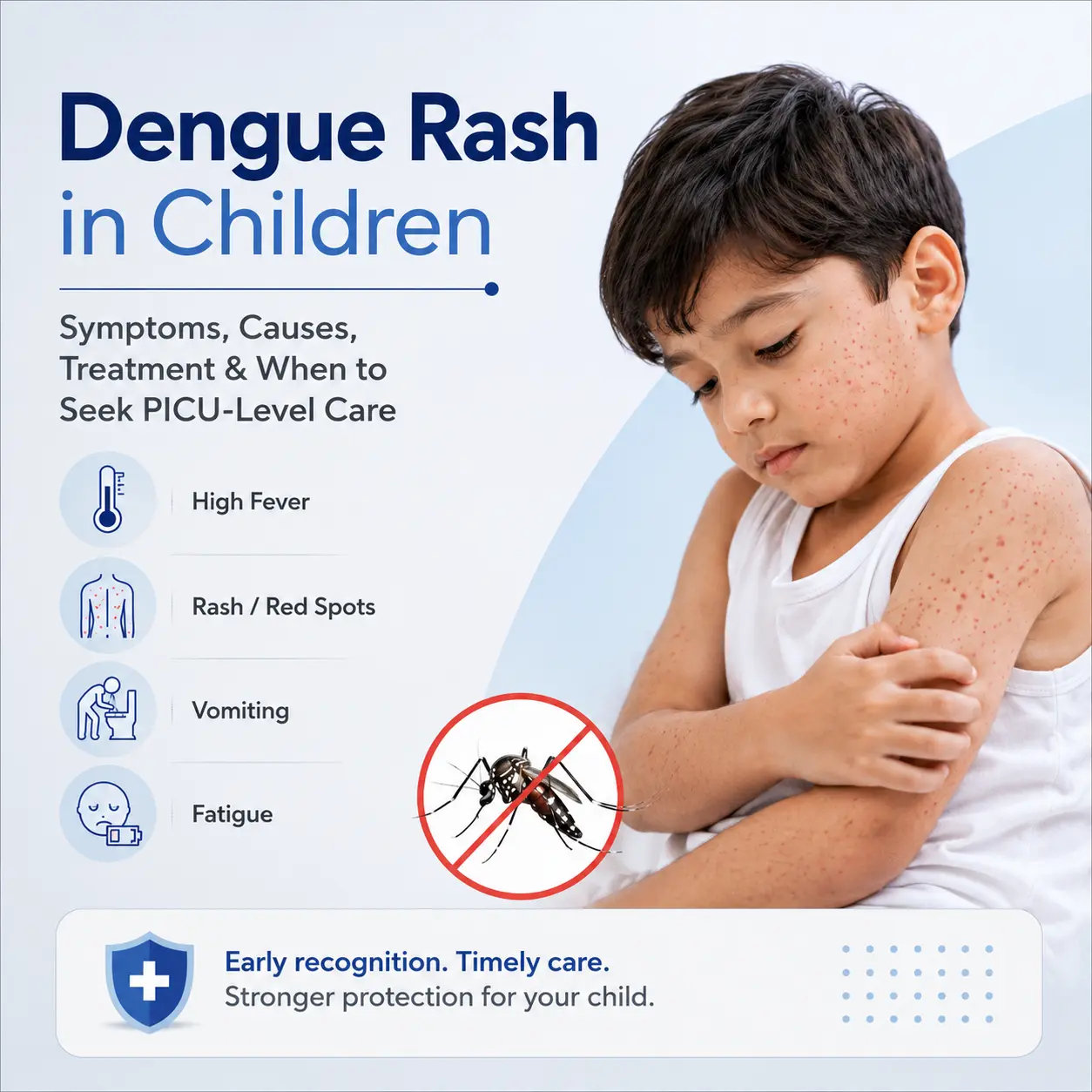
When is a Dengue Rash Serious in Children? Critical Warning Signs Every Parent Should Know
If your child develops a high fever followed by red spots or a skin rash, it's natural to be concerned about dengue. During the monsoon and post-monsoon season in India, dengue is one of the most common mosquito-borne viral infections affecting children. Thi
Unexplained Child Weight Loss: Warning Signs for Parents
Key Takeaways A consistent downward trend on the growth chart matters more than a single low reading. Sudden weight loss in children, persistent appetite changes or digestive symptoms need medical assessment. A child may lose weight despite eating well because of poor abs
Newborn Sneezing: Is it a Cold or Just Normal Reflex? | Rainbow Hospitals
Key Takeaways Frequent sneezing is usually a normal reflex that helps a newborn clear milk droplets, mucus and dust from a narrow nose. Sneezing with comfortable breathing, normal feeds, clear mucus and no fever is generally reassuring. Saline drops, a short wait and gentle