



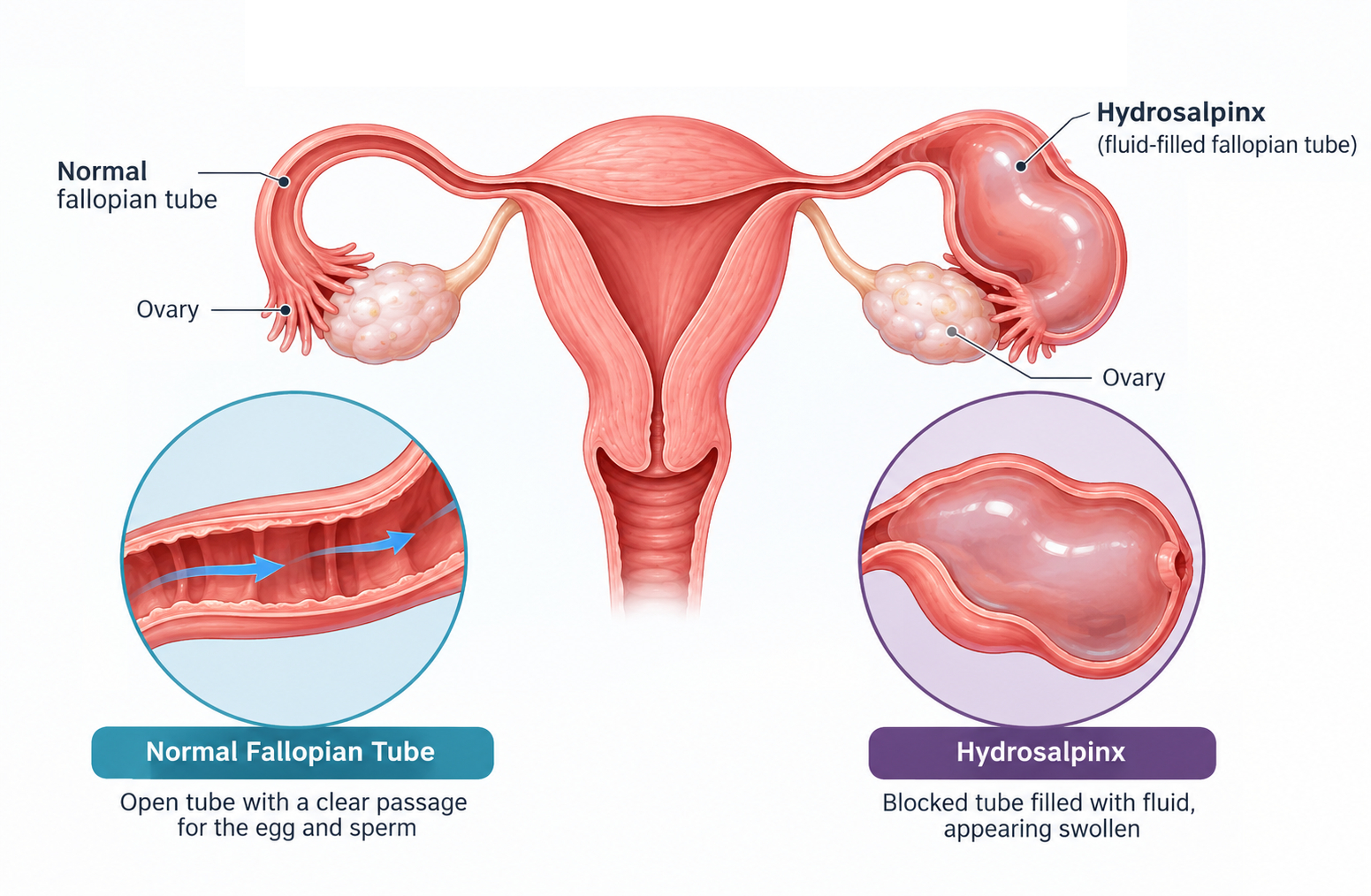
Hydrosalpinx (fluid-filled fallopian tube)
Hydrosalpinx, is a condition in which one or both fallopian tubes get obstructed at the end closest to the ovary and become filled with clear or watery fluid, making the tube swell. It commonly develops after a pelvic infection, earlier surgery, endometriosis or genital tuberculosis. As a major infertility factor, a fluid-filled fallopian tube can make natural pregnancy difficult or even impossible, and it may also reduce the chances of IVF success if it is not treated.

Seamless support from diagnosis to post treatment care
Overview
Hydrosalpinx is a common cause of tubal infertility and is often first found during a fertility evaluation or scan. It can lower the chance of natural conception and, if left untreated, reduce the success of IVF.
If you have been diagnosed with hydrosalpinx, you may want to understand why it has developed, how it can affect fertility and whether treatment is needed before trying to conceive or starting IVF. This page explains its symptoms, causes, effects on fertility, and treatment options you may consider.
What is Hydrosalpinx?
Hydrosalpinx is a condition where a fallopian tube becomes blocked and fills with fluid. The word comes from "hydro", meaning water, and "salpinx", meaning tube. The blockage usually forms at the far end of the tube, near the ovary, so fluid collects and the tube swells. It can affect one tube (unilateral) or both (bilateral).
Hydrosalpinx matters mainly because it affects fertility. Tubal factors are a common cause of infertility in India, accounting for a significant share of cases among couples seeking care. Hydrosalpinx is often discovered during a fertility evaluation rather than from symptoms, which is why many women first hear of it when trying to conceive.
How the Fallopian Tubes Normally Work in Conception
Understanding what the tubes do helps explain why hydrosalpinx affects fertility. The two fallopian tubes connect the ovaries to the uterus. Each month, they play a quiet but essential role in natural conception.
At ovulation, an egg is released from an ovary and drawn into the fallopian tube. Sperm travel up through the uterus to meet it, and fertilisation usually happens inside the tube. The fertilised egg then moves down to the uterus to implant. When a tube is swollen with fluid, this journey is disrupted, and the fluid itself can cause further problems, as the sections below explain.
Causes of Hydrosalpinx
The fallopian tubes are thin, delicate passages, and hydrosalpinx develops when one of them is damaged and its far end seals over. Fluid that the tube lining normally makes then has nowhere to go, so it collects and the tube swells. Several conditions can cause this damage, and the most common are below.
1. Pelvic inflammatory disease (PID)
PID is an infection of the reproductive organs, often caused by untreated sexually transmitted infections such as chlamydia or gonorrhoea. When the infection reaches the fallopian tubes, it can leave inflammation and scarring that seal the delicate end of the tube. It is the leading cause of hydrosalpinx, and even a past infection that felt mild can be responsible.
2. Genital tuberculosis
Genital tuberculosis is a form of TB that affects the reproductive organs, and it remains an important cause of tubal damage in India. It can inflame and scar the fallopian tubes over months or years, often with no obvious symptoms, and is frequently found only when a woman is investigated for difficulty conceiving. TB is treated with medicines, but tube damage may remain afterwards.
3. Previous pelvic or abdominal surgery
Any past surgery in the pelvis or abdomen, such as removal of an ovarian cyst, treatment for an ectopic pregnancy, or an appendix operation, can leave scar tissue behind. When this scarring, called adhesions, forms around a fallopian tube, it can pull on the tube or block its end. As a result, the tube can trap fluid and swell.
4. Endometriosis
Endometriosis is a condition where tissue similar to the lining of the uterus grows outside the womb, often near the ovaries and tubes. This tissue can form sticky adhesions that wrap around or distort the fallopian tubes. Over time, this can damage a tube and lead to hydrosalpinx.
5. Past ectopic pregnancy
An ectopic pregnancy, where a pregnancy grows in the fallopian tube, can damage the tube directly, and so can the treatment needed to manage it. The tube may be left scarred or narrowed afterwards. This damage can set the stage for fluid to collect later.
These causes may act alone or together, and several leave no obvious sign until fertility is affected. Identifying the underlying cause helps your doctor choose the right treatment. A fertility evaluation is the way to find what has affected your tubes.
Risk Factors of Hydrosalpinx
Some women are more likely to develop hydrosalpinx because of a past condition or infection affecting the fallopian tubes. You may be at higher risk if you have.
- A history of pelvic infection: Previous pelvic inflammatory disease or sexually transmitted infections are the strongest risk factors, because they can scar the tubes.
- Previous pelvic or abdominal surgery: Operations in this area can leave adhesions that damage or block a tube.
- Endometriosis: This can form adhesions that distort or affect the fallopian tubes over time.
- A previous ectopic pregnancy: A past pregnancy in the tube, and its treatment, can leave the tube damaged.
- A history of tuberculosis: Genital TB is an important cause of tubal damage in India and raises the risk of hydrosalpinx.
Having a risk factor does not mean you will develop hydrosalpinx, but it is worth mentioning to your doctor. If you are trying to conceive, it may be a reason to have a tubal check sooner. Early testing helps because some tubal damage worsens if left unaddressed.
Symptoms of Hydrosalpinx
One of the difficult things about hydrosalpinx is that many women have no symptoms at all, and difficulty conceiving is often the first and only sign. When symptoms do appear, they can be mild and easy to dismiss as something else. The possible signs are below.
- Difficulty getting pregnant: This is frequently the first clue, because a blocked, fluid-filled tube stops the egg and sperm from meeting. Many women only learn they have hydrosalpinx during a fertility evaluation.
- Pelvic or lower abdominal pain: Some women feel an ache or discomfort in the lower abdomen, sometimes on one side where the swollen tube sits. It may be constant or come and go.
- A feeling of heaviness in the pelvis: A swollen, fluid-filled tube can create a dull sense of pressure or heaviness. This often goes unnoticed or is mistaken for ordinary period discomfort.
- Unusual vaginal discharge: In some women, particularly when an infection is involved, there may be a change in vaginal discharge. Mention this to your doctor.
Because these signs are mild or absent, doctors usually find hydrosalpinx during a fertility scan or test rather than from symptoms. That's why a proper evaluation matters if you are struggling to conceive. A simple tubal test can confirm whether hydrosalpinx is present.
How is Hydrosalpinx Diagnosed?
Hydrosalpinx is usually found through imaging, often during an infertility workup rather than because of symptoms. A few straightforward tests confirm hydrosalpinx and show how badly the tube is affected.
- Ultrasound: A pelvic ultrasound scan can often show a fluid-filled, swollen tube, which appears as a sausage-shaped structure. It is painless and is usually the first test that raises the possibility of hydrosalpinx.
- Hysterosalpingography (HSG): This dye test passes contrast through the cervix, and X-rays show whether the tubes are open or blocked, and where. It helps map the tubes and confirm the blockage.
- Laparoscopy: A hydrosalpinx laparoscopy is a keyhole look inside the pelvis under anaesthesia, which confirms the condition directly. It lets the surgeon assess the tubes and nearby organs, and sometimes allows treatment in the same procedure.
These tests also help your doctor plan the right treatment, particularly if you are considering IVF. The findings guide whether a tube should be treated before fertility treatment begins. Your specialist will explain what your results mean for you in plain language.
Complications of Hydrosalpinx
The main concern with hydrosalpinx is its effect on fertility, and it is worth understanding clearly because the trapped fluid can do more harm than the blockage alone. Knowing why also explains why doctors treat it the way they do. The key complications are below.
- Difficulty conceiving naturally: A blocked, fluid-filled tube stops the egg and sperm from meeting on that side. If both tubes are affected, natural conception becomes very unlikely, which is often what brings a woman in for tests.
- Lower IVF success: This is the most important point. The trapped fluid can leak back into the uterus, where it can flush out an embryo or be harmful to it, reducing the chance of implantation. This is the single biggest reason doctors treat hydrosalpinx before an IVF cycle.
- A higher risk of ectopic pregnancy: A damaged tube raises the chance of a fertilised egg implanting in the wrong place, inside the tube rather than the uterus. This is a situation doctors watch for carefully.
- Ongoing pelvic discomfort: In some women, the swollen tube causes recurring pelvic pain or a sense of pressure, even apart from the effect on fertility.
The effect on IVF is the reason doctors so often recommend treating hydrosalpinx before a cycle begins. Addressing it first protects your chance of a successful pregnancy. The next section explains the treatment options in plain terms.
Treatment Options for Hydrosalpinx
Treatment for hydrosalpinx aims to remove the harmful effect of the fluid and give you the best chance of pregnancy. There is no single answer, because the right choice depends on your fertility goals, your age and the state of the tubes. The main options are explained below.
- Salpingectomy (removal of the tube): This is the surgical removal of the affected tube, usually done by keyhole (laparoscopic) surgery through small cuts. It is the most common approach before IVF, because taking the tube away removes the harmful fluid completely. Your ovaries and hormones are not affected, and recovery is usually quick.
- Tubal occlusion or clipping: Here the affected tube is sealed or clipped so its fluid can no longer flow back into the uterus. It is a useful option when removing the tube would be difficult, for example because of dense scar tissue. It gives similar protection for an IVF cycle.
- Salpingostomy (opening the tube): This involves opening the blocked end of the tube to try to restore its function. It is sometimes considered for women who hope to conceive naturally, though the results vary and hydrosalpinx can return. Your specialist will explain whether it is realistic for you.
- IVF after treatment: Once the hydrosalpinx has been treated, IVF bypasses the tubes altogether by fertilising the egg in the laboratory. For most women with hydrosalpinx, this is the strongest route to pregnancy.
For most women planning IVF, treating the hydrosalpinx first gives the best outcome, which is why surgery and IVF are usually planned together. Our IVF page explains that treatment in detail. Your specialist will recommend the option that fits your situation and your plans for a family.
What is the Prognosis (Outlook) After Treatment?
The outlook after treating hydrosalpinx is encouraging, and this is worth holding onto. Removing or sealing the affected tube stops the fluid from harming an embryo, which improves the chance of pregnancy with IVF compared with no treatment.
Research supports this clearly. Reviews of the evidence show that treating hydrosalpinx before IVF, usually by removing the tube, improves the clinical pregnancy rate compared with no treatment. In other words, a step that feels drastic is what gives many women their best chance of a healthy pregnancy. Your specialist can give you a realistic estimate based on your own circumstances.
What Questions Should You Ask Your Doctor?
Bringing a few questions to your appointment helps you understand your options. The prompts below are grouped by theme. Add any of your own.
Diagnosis and treatment choice questions
- Is one tube affected or both, and how badly?
- Which treatment do you recommend for me, and why?
- What does the surgery involve, and what is the recovery like?
Fertility and IVF planning questions
- Should the hydrosalpinx be treated before I start IVF?
- How will treatment affect my chances of a successful pregnancy?
- What are my options if I would prefer to try to conceive naturally?
Do not hesitate to ask your doctor to explain any term you do not understand. Clear answers help you decide the next step with confidence. Writing them down can help you remember afterwards.
Prevention and Early Detection Tips for Hydrosalpinx
You can't prevent every case of hydrosalpinx, but you can often lower the risk of tubal damage. Early detection also makes treatment simpler. The steps below help.
- Use protection during sex to reduce the risk of sexually transmitted infections.
- Get any suspected pelvic infection tested and treated promptly.
- Keep up regular gynaecological check-ups.
- Tell your doctor about any past tuberculosis or pelvic surgery.
- Seek a fertility evaluation early if you are struggling to conceive.
These steps focus on protecting the tubes from infection and scarring, the main causes of hydrosalpinx. Where damage has already occurred, early detection still helps by allowing timely treatment. If you have risk factors, a tubal check matters more than prevention alone.
Why Choose BirthRight Fertility by Rainbow Hospitals for Hydrosalpinx Treatment?
Hydrosalpinx sits where gynaecological surgery and fertility care meet, so a team that offers both is best suited to manage it. That is what BirthRight Fertility by Rainbow Hospitals provides. The points below show what that means for you.
- Accurate diagnosis: Ultrasound, HSG and diagnostic laparoscopy to confirm hydrosalpinx and assess the tubes.
- Minimally invasive surgery: Keyhole salpingectomy and related procedures for suitable cases.
- Coordinated IVF care: Joined-up planning from tubal treatment through to IVF, under one team.
- Counselling and support: Because a fertility diagnosis affects you emotionally as well as medically.
BirthRight Fertility by Rainbow Hospitals brings three decades of fertility expertise, with thousands of successful gynaecological surgeries and more than 100,000 parenthood journeys supported across 15 Level II fertility centres in India. If you have been diagnosed with hydrosalpinx, our fertility specialists can assess your tubes and plan the right path to pregnancy. A consultation is a good first step.
Disclaimer
This content is for general educational purposes and does not replace professional medical advice. Hydrosalpinx varies between individuals, and outcomes depend on your circumstances. Consult a qualified gynaecologist or fertility specialist for diagnosis and treatment suited to your own case.

Find a Doctor
Expertise you can trust, Meet our esteemed doctors who bring exceptional knowledge, compassion, and innovation to provide top-notch care for your health and well-being.

Dr. Ratna Durvasula
Consultant Fertility Specialist
English,Telugu Kondapur OP, Banjara Hills, Financial District, Kondapur IP

Dr. Sudharani Bairraju
Senior Consultant Obstetrician and Gynaecologist, Laparoscopic surgeon and Infertility (IVF) Specialist
English,Telugu Banjara Hills

Dr. Lakshmi Chirumamilla
Fertility Specialist and Reproductive Endocrinologist
25 Years English,Hindi,Telugu Banjara HillsLeading Hospitals for Fertility Care
Rainbow Children's Hospital stands as a testament to the hospital's continual pursuit of excellence and innovation, providing specialized care for women and children













chennai
Blogs
Discover our most recent health articles provided by our reliable experts.




What Are People Saying About Us
Embark on a journey of inspiration and hope with our patient success stories, complemented by informative videos from our dedicated doctors.





Media
 Dr. Preethi Reddy Article on Lifestyle Changes to Improve Fertility | BirthRight Fertility by Rainbow
 Dr. Ratna Duravasula Sr. Infertility Specialist
 Surrogacy, a Boon when Normal
 Surrogacy, a Boon when Normal Pregnancy is Medically Inadvisable
 Fertility... Modern Treatments
 A month after covid subsided....
 Can the baby's heartbeat be heard in an ectopic pregnancy?
 Doctors Exploit Loopholes in Bill
 Fertility counseling
 JCI Accreditation
 Menstrual cramps
 So Why are Men Turning into Women?
 Hysteroscopy- Procedure Of Choice For Intrauterine Problems
 Diet and Exercise in Pregnancy- Bust your Myths and Know your Facts
 Recurrent Pregnancy Loss
 Do Laptops, Excessive Heat and Tight Jeans Cause Infertility?
 In Vitro Fertilization
 Menstrual cup – are we really aware of it?
 No More Worries About Menopause
 Stretch marks in pregnancy: Embracing the scars
 Egg Freezing
 Fertility Preservation: Methods and Indications for Securing Reproductive Options
 Tips for planning a pregnancy
 Inferticity
 Here is all what you need to know about IVF, the popularly known fertility treatment
 Delayed marriage among factors for birth rate dip
 Fertility against Odds: IVF hope for women above 40 years of age
 Will Pregnancy Cure Endometriosis?
 Postpartum Depression: Expert Lists Essential Foods Prevent Depression in New Mothers
 Complications of Gestational Diabetes During Pregnancy by Dr. Triveni Arun Akkiraju
 Five Key Sexual Health Facts for Women
 Six Reasons That May Cause IVF Failure
 దంపతుల్లో ఈ మూడు లోపాలుంటే పిల్లలు పుట్టరు
 IVF and Genetic Testion - Essential Insights
 In vitro fertilization (IVF)
 About In Vitro Fertilization
 What is the IVF cost?
 What is the cost of IVF?
 Tick-Tock on Biological clock: Fertility concerns multiply in Telugu States
 Diminished Ovarian Reserve (DOR): Causes, Diagnosis, and Treatment Options by Dr. Shreeja Karan
 25 Years of Anniversary - Rainbow Children's Hospital & BirthRight
 Rising infertility: Addressing Challenges with Laparoscopy & Hysteroscopy
Dr. Preethi Reddy Article on Lifestyle Changes to Improve Fertility | BirthRight Fertility by Rainbow
Dr. Ratna Duravasula Sr. Infertility Specialist
Rising infertility: Addressing Challenges with Laparoscopy & Hysteroscopy
Dr. Preethi Reddy Article on Lifestyle Changes to Improve Fertility | BirthRight Fertility by Rainbow
Dr. Ratna Duravasula Sr. Infertility Specialist
 Surrogacy, a Boon when Normal
FAQs
Can I get pregnant naturally with hydrosalpinx?
Does hydrosalpinx always need to be removed before IVF?
Will removing my fallopian tube affect my hormones or periods?
Can hydrosalpinx come back after treatment?
Is hydrosalpinx the same as a blocked fallopian tube?
Can hydrosalpinx cause an ectopic pregnancy?
Is hydrosalpinx surgery a major operation?
Can I still use IVF if only one tube has hydrosalpinx?
How is hydrosalpinx diagnosed if I have no symptoms?
Does hydrosalpinx mean I will never conceive?
Can you treat hydrosalpinx without surgery?
Quick Links
Free Calculators to Track and Predict your Pregnancy
Fertility Specialist in Other Locations
- Fertility Specialist in India
- Fertility Specialist in Hyderabad
- Fertility Specialist in Bangalore
- Fertility Specialist in Chennai
- Fertility Specialist in Delhi (NCR)
- Fertility Specialist in Vijayawada
- Fertility Specialist in Vishakhapatnam
- Fertility Specialist in Guwahati
- Fertility Specialist in Rajahmundry
- Fertility Specialist in Guntur