




Placenta Accreta: Causes, Symptoms and Delivery Management
Placenta accreta may be suspected during pregnancy scans when the placenta appears to be attached more deeply to the uterus than expected. Because this can affect how the placenta separates after birth, doctors may recommend closer assessment and careful planning for delivery.
Finding the condition before labour gives the maternity team time to assess the placental attachment and prepare for possible bleeding or other complications during birth. That planning begins with understanding what placenta accreta is and why it may require additional care during pregnancy and delivery.
What is Placenta Accreta?
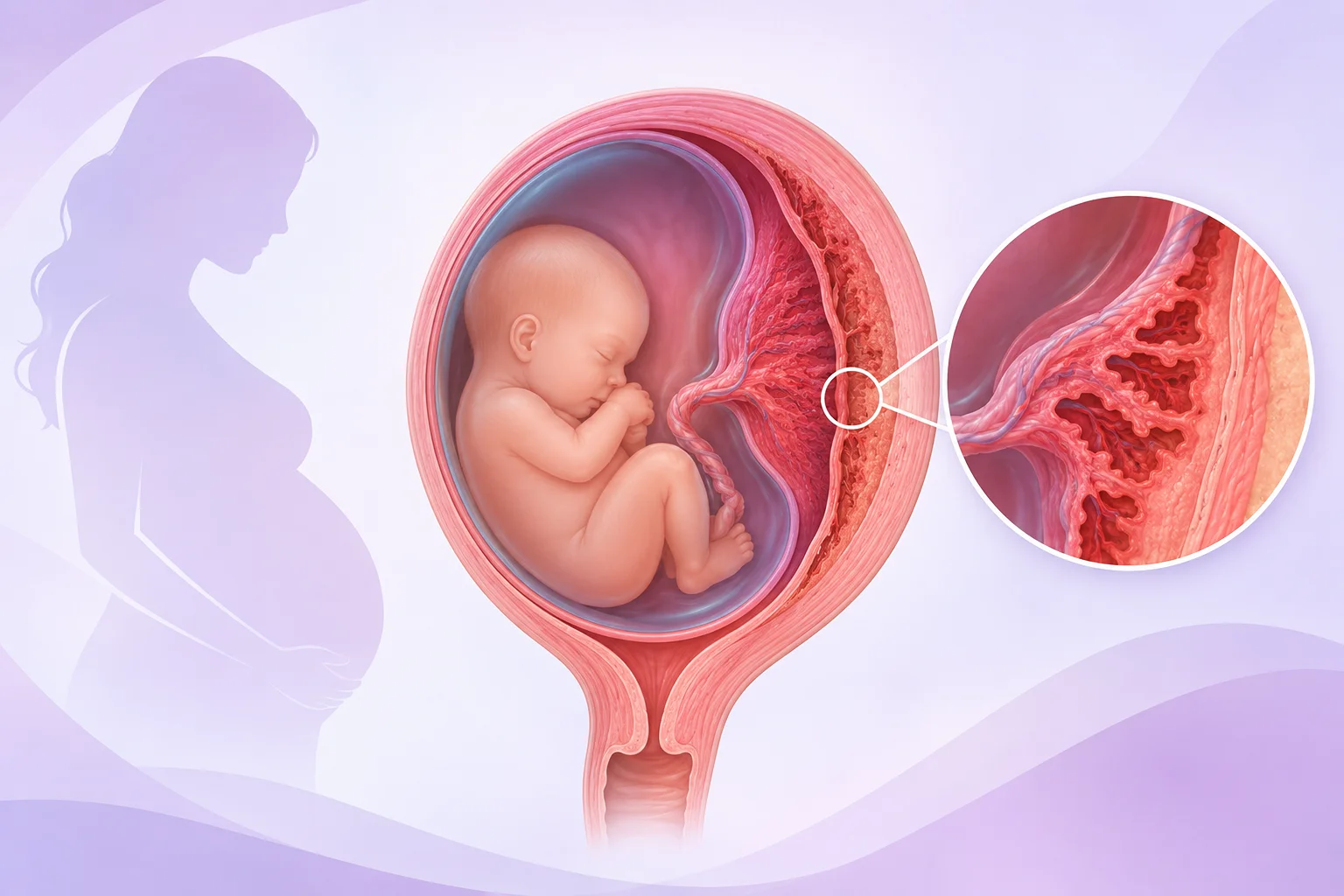
The placenta is the organ that develops during pregnancy to supply the baby with oxygen and nutrients. It attaches to the wall of the uterus and normally separates from the uterus after the baby is born.
In placenta accreta, the placenta attaches more deeply than usual and may not separate easily after delivery. This can lead to heavy bleeding, which is why the condition needs careful monitoring and delivery planning.
Types of Placenta Accreta
Placenta accreta is part of a group called the placenta accreta spectrum (PAS). The types are based on how deeply the placenta is attached:
- Placenta accreta: The placenta is attached abnormally to the wall of the uterus.
- Placenta increta: The placenta grows into the uterine muscle.
- Placenta percreta: The placenta grows through the uterine wall and may reach nearby organs.
Your doctor can identify the type and explain what it may mean for your pregnancy and delivery.
How Does Placenta Accreta Affect Pregnancy and Delivery?
Placenta accreta mainly changes how your doctor monitors and plans your pregnancy and delivery. During pregnancy, the condition does not usually interfere with the baby’s growth, but at BirthRight by Rainbow Hospitals, doctors may recommend closer follow-up as delivery approaches.
The greater concern is around childbirth because the placenta may remain firmly attached after the baby is born. This increases the risk of heavy bleeding and means the delivery needs to be carefully planned.
When placenta accreta is identified before birth, the maternity team can decide the safest approach to delivery, which is often a planned caesarean section. It also gives the team time to prepare for bleeding and arrange any additional care that may be required.
What Causes Placenta Accreta?
The main cause of placenta accreta is the placenta implanting into scar tissue rather than the healthy lining of the uterus. Scar tissue usually comes from previous surgery on the uterus, most often a caesarean. When the placenta settles over a scar, it can grow deeper than it should as it seeks a good blood supply.
Placenta accreta has become more common as caesarean births have increased, particularly because a previous caesarean can increase the risk of the placenta attaching abnormally in a future pregnancy. It is not caused by anything a woman does during pregnancy, including her diet or physical activity. Instead, the risk is mainly linked to factors such as previous surgery on the uterus and the position of the placenta in the current pregnancy.
Risk Factors of Placenta Accreta
Certain pregnancy and uterine history factors can increase the chances of placenta accreta. A previous caesarean delivery is an important risk factor, and the likelihood increases with the number of caesarean deliveries a woman has had. Other factors may also contribute and are considered when doctors assess the pregnancy.
- A previous caesarean: A past C-section is the main risk factor, and the risk climbs with each one.
- Placenta previa: When the placenta lies low and covers the cervix, often alongside accreta.
- Previous uterine surgery: Surgery such as fibroid removal or a D&C can leave scar tissue.
- Endometrial ablation: A past procedure to treat the lining of the womb.
- Older maternal age: The risk is slightly higher in older mothers.
- IVF pregnancy: Conceiving through IVF is linked with a modestly higher risk.
Symptoms of Placenta Accreta
One tricky thing about placenta accreta symptoms is that there are usually none. Most women feel completely well, and doctors find the condition on an ultrasound rather than through symptoms. When a sign does appear, it is usually bleeding. The possible signs are below.
- No symptoms: Most cases cause no symptoms and are found only on a scan.
- Vaginal bleeding: Some women have bleeding, more often in the later part of pregnancy.
- Bleeding linked with placenta previa: When previa is also present, painless bleeding can occur.
Complications of Placenta Accreta
The main risks of placenta accreta come at the time of delivery rather than during the pregnancy. Knowing them explains why delivery is so carefully planned. The main complications are below.
- Heavy bleeding: Severe bleeding at delivery is the main risk when the placenta does not separate.
- Blood transfusion: A transfusion is often needed to replace lost blood.
- Hysterectomy: Removing the uterus is sometimes needed to control bleeding safely.
- Injury to nearby organs: In the severe percreta form, the bladder or bowel can be involved.
- Preterm birth: Delivery is often planned a few weeks early to avoid an emergency.
Treatment Options for Placenta Accreta
Clinicians usually manage placenta accreta by carefully planning the delivery rather than treating it during pregnancy. It is often identified on an ultrasound scan in the second or third trimester, and an MRI may be used for further assessment.
- Planned caesarean: Delivery is usually planned before labour begins, often around 39 weeks depending on your situation.
- Experienced centre: Delivery is planned at a hospital experienced in managing placenta accreta.
- Specialist team: Doctors, blood products and equipment are prepared in case heavy bleeding occurs.
- Caesarean hysterectomy: The uterus may be removed after the baby is delivered to help control bleeding.
- Conservative management/ Medical management: In some cases, placenta is left in place, it requires constant monitoring with serial Beta HCG. Some selected cases may require methotrexate therapy. In these cases there is an increased risk of infection.
What is the Prognosis (Outlook) for Placenta Accreta?
The prognosis for placenta accreta depends on factors such as how deeply the placenta is attached, whether the condition is diagnosed before delivery, and the amount of bleeding during childbirth. Early diagnosis allows our doctors to plan the delivery and prepare for complications that may need immediate treatment.
Recovery can vary from one woman to another depending on the extent of the condition and the treatment required. In some cases, a hysterectomy may be necessary to control severe bleeding. Careful monitoring and planned delivery with an experienced maternity team can help reduce the risk of serious complications.
What Questions Should I Ask My Doctor?
Going into your appointment with a few questions ready helps you understand your own situation. The prompts below are grouped to make them easier to use. There are no wrong questions about your pregnancy.
Diagnosis and monitoring questions
- Which type of accreta do I have, and how deep is it?
- Do I need an MRI as well as the ultrasound?
- How often will I be scanned and monitored from now on?
- What symptoms should prompt me to come in straight away?
Delivery planning questions
- When and where will my delivery be planned?
- Is a hysterectomy likely, or can the uterus be preserved?
- Will I need a blood transfusion, and how is that prepared for?
- What does recovery look like after this kind of delivery?
Writing your questions down helps you prepare and gain clarity after the meeting. A clear conversation helps you feel more in control of your care. Our team is there to guide you every step of the way.
Prevention and Precaution Tips for Placenta Accreta
Placenta accreta cannot always be prevented, as it depends largely on past surgery and where the placenta implants. Some steps lower the risk or help recognise it early. The practical points below help.
- Avoid unnecessary uterine surgery: Having a caesarean or other uterine surgery only when it is medically needed lowers future risk.
- Attend your scans: Regular scans, especially after a caesarean, help find accreta early.
- Share your surgical history: Tell your doctor about any past uterine surgery so they can monitor you carefully.
- Report any bleeding: Tell your doctor about any bleeding in pregnancy straight away.
None of this guarantees you will avoid accreta, which is not a personal failing. The focus is on early diagnosis and planning, not prevention alone. Good antenatal care gives your team the chance to prepare.
Why Choose BirthRight by Rainbow Hospitals for Placenta Accreta Care?
BirthRight by Rainbow Hospitals brings together obstetricians, maternal-foetal medicine specialists and newborn care under one roof, backed by three decades of expertise in women’s and children’s health. Placenta accreta needs accurate diagnosis and a carefully planned delivery with the right support on hand, and our teams are set up for exactly this. From detailed scans to a prepared surgical team, we coordinate your care so nothing is left to chance.
If heavy bleeding occurs or your baby needs to arrive early, you have access to high-risk delivery care and a well-equipped neonatal unit in the same place. This means help is ready whatever your delivery brings. The aim throughout is early diagnosis, a safe planned delivery and steady support for you and your baby.