




Hysteroscopy
Hysteroscopy is a procedure in which a thin, lighted telescope is passed through the vagina and cervix to look inside the uterus. It can find the cause of abnormal bleeding or difficulty conceiving and, in the same sitting, remove polyps, fibroids or scar tissue.

Seamless support from diagnosis to post treatment care
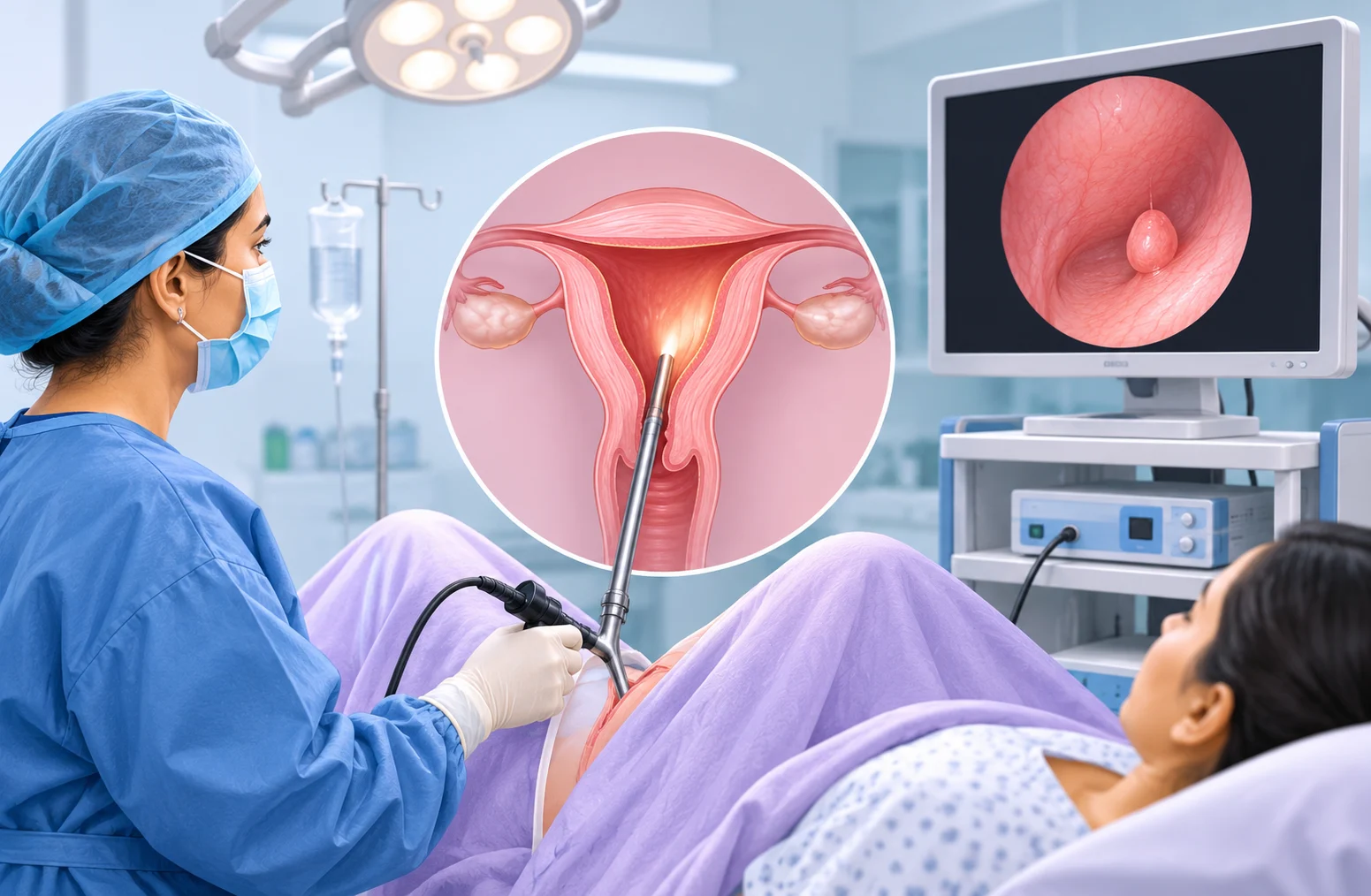
Overview
Hysteroscopy is a procedure that allows doctors to look inside the uterus and, in some cases, treat certain problems at the same time. Your doctor may recommend it if you have abnormal bleeding, uterine polyps or certain fertility concerns.
Understanding why hysteroscopy is advised and what happens during the procedure can help you know what to expect. Here we explain how hysteroscopy is performed, what recovery may involve, possible side effects, and the cost of the procedure in India.
What is Hysteroscopy?
Hysteroscopy is an endoscopy of the uterus. A thin, lighted telescope called a hysteroscope is inserted gently through the vagina and cervix, so your doctor can see the inside of the uterus on a screen. No cuts are made.
It can be one of two types, depending on why it is done:
- Diagnostic hysteroscopy: To examine the inside of the uterus and identify the cause of a problem. It may be performed with little or no anaesthesia, depending on the situation.
- Operative hysteroscopy: To treat certain problems during the same procedure, such as removing a uterine polyp or a fibroid that projects into the uterine cavity. Anaesthesia may be used depending on the procedure.
Often the two are combined, so a problem seen during the look is treated straight away. A normal hysteroscopy means the inside of the uterus looks healthy, with no polyps, fibroids, or other changes.
Who Needs Hysteroscopy, and When is it Recommended?
A hysteroscopy is recommended when a scan or a symptom points to a problem inside the uterus that needs a closer look. Your doctor may suggest the test if you have:
- Heavy, irregular or unexplained bleeding
- Bleeding after menopause
- A polyp, fibroid or thickening seen on ultrasound
- Repeated miscarriages or difficulty conceiving
- A need to remove a displaced contraceptive coil
It often provides a clear answer after a scan has only hinted at something. Your gynaecologist decides whether a hysteroscopy is the right next test for you.
Conditions Hysteroscopy Can Diagnose and Treat
Hysteroscopy can diagnose and treat a range of uterine conditions. These fall into two groups: structural problems and fertility-related uses.
Structural conditions:
- Uterine polyps, treated by hysteroscopic polypectomy, a common hysteroscopy polyp removal procedure
- Submucosal fibroids that bulge into the uterine cavity
- Scar tissue inside the uterus (Asherman’s syndrome)
- A uterine septum, a wall of tissue dividing the cavity
Fertility-related uses:
- Hysteroscopy for infertility, to check the cavity when conception is difficult
- Hysteroscopy before IVF, where a pre-IVF check makes sure the uterus is ready for an embryo
- Investigating recurrent miscarriage, including genital tuberculosis of the endometrium, a recognised cause in India
Finding and removing a uterine polyp or septum and treating it can ease heavy bleeding and improve the chance of a pregnancy. Your doctor will explain which applies to you.
Preparing for Hysteroscopy: Tests Before the Procedure
A little preparation makes the procedure smoother and safer. Your team guides you on the timing and what to expect. Preparation usually includes:
- Cycle timing: Your doctor may schedule hysteroscopy after your period has ended and before ovulation, when the uterine lining is thinner and easier to examine.
- A pregnancy test: To confirm you are not pregnant before the procedure.
- A hysteroscopy biopsy plan: If a tissue sample is needed, we discuss this beforehand so we can send the results for testing.
- Anaesthesia discussion: You and your doctor agree on no anaesthesia, local anaesthesia, or general anaesthesia, based on the procedure.
If general anaesthesia is planned, you will be asked to fast beforehand. Your doctor gives you clear instructions for the day.
Hysteroscopy Procedure: Step by Step
Knowing what happens can settle a lot of nerves. The hysteroscopy procedure is short, often taking 15 to 60 minutes. Here is how the procedure unfolds.
Step 1: Getting ready
You lie comfortably as for a routine pelvic exam. Any anaesthesia agreed beforehand is given, from none for a simple look to general anaesthesia for treatment.
Step 2: Inserting the hysteroscope
The thin hysteroscope is passed gently through the vagina and cervix into the uterus. A little fluid or gas opens the cavity so the view is clear.
Step 3: Examining the uterus
Your doctor views the lining of the uterus on a screen, checking for polyps, fibroids, scar tissue or other changes.
Step 4: Treating and sampling
If a problem is found, your doctor can often treat it then, such as removing a polyp. A small tissue sample may be taken for testing where needed.
Step 5: Recovery and going home
The doctor removes the hysteroscope, and you rest for a short while. Most women go home the same day, often within a few hours.
Side Effects, Risks and Safety of Hysteroscopy
Hysteroscopy is generally safe, and most women recover without complications. However, the risks may vary depending on whether it is performed for diagnosis or treatment.
Common hysteroscopy side effects:
- Mild period-like cramps, usually settling within a day
- Light spotting or bleeding for a few days
- Temporary watery vaginal discharge
Rare hysteroscopy complications:
- Uterine perforation: A small hole in the uterine wall, reported in approximately 0.1–1% of procedures. The risk may be higher during operative hysteroscopy.
- Infection: Uncommon, with reported rates of approximately 0.01–1.4%.
- Fluid overload: Excessive absorption of the fluid used during the procedure can cause fluid imbalance or low blood sodium (hyponatraemia), particularly during complex operative procedures using glycine.
- Bleeding or cervical injury: Excessive bleeding or a small tear in the cervix may occasionally occur.
- Intrauterine adhesions: Scar tissue may form after fibroid or uterine septum removal and sometimes affect menstrual periods or fertility.
- Anaesthesia reactions: Side effects or, rarely, serious reactions may occur with general or regional anaesthesia.
When may hysteroscopy be postponed?
Your doctor may delay or reconsider the procedure in cases of:
- Pregnancy
- Active pelvic infection
- Heavy bleeding that obscures the uterine cavity
- Known cervical cancer requiring specialist assessment
How can discomfort be reduced?
Vaginoscopic hysteroscopy, which does not require a vaginal speculum, is generally less painful. Your doctor may also recommend an NSAID, such as ibuprofen, about an hour before the procedure, if suitable, or local anaesthesia when needed.
Most after-effects settle within a day or two. Contact your doctor if you experience fever, severe abdominal pain, heavy bleeding or foul-smelling vaginal discharge.
When to Seek Urgent Care After Hysteroscopy?
Most women recover smoothly, and mild cramping or light spotting is normal. A few signs, though, need prompt medical attention rather than waiting. Contact your doctor or go to a hospital if you have:
- A fever or chills
- Heavy vaginal bleeding, soaking through protection
- Severe or worsening abdominal or pelvic pain
- A foul-smelling vaginal discharge
These can point to an infection or, rarely, another complication, and they are treated easily when caught early. When in doubt, it is always safer to call your doctor than to wait for the symptoms to come out.
Cost of Hysteroscopy in India
Hysteroscopy cost depends mainly on whether it is diagnostic or operative, the hospital and your city. Figures here are indicative, so confirm current pricing with the hospital. As a broad guide:
- Diagnostic hysteroscopy: Around ₹………to ₹……….
- Operative hysteroscopy: Around ₹………to ₹………., depending on what is treated
Anaesthesia, tissue testing and follow-up can add to the total. Many health insurance policies in India cover hysteroscopy when it is medically necessary, so it is worth checking your cover.
After Hysteroscopy: Recovery, Periods and Next Steps
Hysteroscopy recovery is usually quick. Most women return to normal activities within a day after diagnostic hysteroscopy, while operative procedures may require a few extra days. Rest for the remainder of the procedure day and avoid strenuous activities until you feel comfortable.
What to expect during recovery:
- Bleeding: Light spotting may last 3–7 days after diagnostic hysteroscopy and up to 1–2 weeks after operative hysteroscopy.
- Period changes: Your next period may arrive earlier or later than expected and may be slightly heavier than usual. These changes generally settle within one or two menstrual cycles.
- Pain relief: Mild cramps can be managed with paracetamol or ibuprofen, if suitable for you.
- Hygiene and intimacy: Use sanitary pads instead of tampons. Avoid sex, tampons, swimming and baths until bleeding stops, which may take around 1–2 weeks.
When can you try to conceive after hysteroscopy?
After an uncomplicated diagnostic hysteroscopy or polyp removal, you can generally try to conceive after your next normal period once your doctor confirms it is safe. After uterine septum removal, doctors usually recommend waiting 1–2 months. Following adhesiolysis (removal of scar tissue), you may need to wait around 6–8 weeks, particularly if an intrauterine device (IUD) or balloon has been placed, and until follow-up confirms adequate healing.
What happens after the procedure?
If a biopsy was taken, results may take one to two weeks or longer, depending on the laboratory. Your doctor will discuss the findings and recommend any further treatment. Antibiotics are prescribed if an infection is suspected or diagnosed, rather than routinely after every hysteroscopy.
Contact your doctor if you experience fever, severe or worsening abdominal pain, heavy bleeding or foul-smelling vaginal discharge.
What Questions Should You Ask Your Doctor?
The right questions depend on where you are in the process. It helps to prepare them before your visit. The prompts below are grouped by stage.
Before the procedure:
- Is my hysteroscopy diagnostic, operative or both?
- What type of anaesthesia will I need?
About recovery:
- When can I return to work and normal activity?
- What bleeding or discharge is normal, and what is a warning sign?
About results and fertility:
- When will my biopsy results be ready?
- How soon can I try to conceive after this?
Ask your doctor to explain any term you do not follow. Clear answers help you go in feeling prepared.
Why Choose BirthRight by Rainbow Hospitals for Hysteroscopy?
A good hysteroscopy needs the right equipment and a gynaecologist who does the procedure often, especially when treatment and fertility are involved. BirthRight by Rainbow Hospitals brings both together. For hysteroscopy specifically, our care includes:
- Advanced hysteroscopy technology: Modern scopes for a clear view and precise treatment.
- Day-care setup: Most procedures are done as day-care, so you go home the same day.
- See-and-treat approach: Find and treat a problem in one sitting, where possible.
- Gynaecology and fertility together: Coordinated care when hysteroscopy is part of a fertility workup.
- Experienced specialists: Gynaecologists skilled in diagnostic and operative hysteroscopy.
You can consult the gynecologists at BirthRight by Rainbow Hospitals to discuss whether a hysteroscopy is right for you.

Find a Doctor and Book Appointment Online
Meet our specialist doctors who bring together clinical expertise, compassion, and personalised care to support your health and well-being. Choose from 1,300+ specialists across our network and book an appointment with BirthRight and Rainbow Children Hospitals, offering 24*7 support to you and your family.

Dr. Pranathi Reddy A
Clinical Director – Obstetrics & Gynecology.
English,Hindi,Telugu Banjara Hills

Dr. Gauri Vinayak Dhamangaonkar
Senior Consultant - Fetal Medicine
15 Years English,Hindi,Marathi,Telugu Kondapur OP, Banjara Hills

Dr. Shruthi Reddy Poddutoor
Consultant Obstetrician, Gynecologist & Laparoscopic Surgeon
English,Telugu Banjara Hills

Dr. Himabindu Veerla
Consultant Obstetrician, Gynecologist & Laparoscopic Surgeon
English,Telugu Banjara Hills

Dr. Bhargavi Reddy K
Consultant - Obstetrics and Gynecology
10 Years English,Hindi,Telugu Banjara Hills, Attapur Clinic

Dr. Annie Pranutha P
Consultant Obstetrics and Gynecology
9 Years English,Hindi,Telugu Banjara Hills, Attapur Clinic

Dr. Sasikala Kola
Consultant Obstetrician & Gynecologist
English,Hindi,Telugu Banjara Hills

Dr. Atigadda Vijaya
Consultant - Obstetrics & Gynecology
Hindi,Telugu Banjara Hills, Himayatnagar, Attapur Clinic

Dr. Nishanth Reddy Inavolu
Visiting Consultant Physician and Diabetologist & Internal Medicine
English,Hindi,Telugu Banjara Hills, Himayatnagar

Dr. Tulika Tayal
Consultant - Fetal Medicine
English,Telugu Banjara Hills

Dr. M Prathyusha Reddy
Consultant Obstetrics & Gynecology
English,Telugu Banjara Hills

Dr. Nithya Narasimha Murthy
Consultant -Psychiatrist
English,Hindi,Telugu Kondapur OP, Banjara Hills, Child Development Centre - Banjarahills Rd No 10

Dr. Brundavani
Consultant - Nutritionist
English,Hindi,Telugu Kondapur OP, Hydernagar, Banjara Hills, Child Development Centre - Banjarahills Rd No 10

Dr. Niveditha Chalmeda
Consultant
English,Telugu Banjara Hills

Dr. Kirti Reddy Patlolla
Consultant Obstetrics and Gynaecology
English,Telugu Banjara Hills, Attapur Clinic

Dr. Tuheena Sharma
Consultant - Perinatal Physiotherapy
10 Years English,Telugu Banjara Hills

Dr. Aditi Shah
Consultant - Fetal Medicine
English,Telugu Banjara Hills

Dr. Swathi Naga Tulasi Rayapureddy
Lactation Consultant
8 Years English,Telugu Banjara Hills

Dr. Swetha Reddy. S
CONSULTANT PERINATAL PSYCHIATRIST AND WOMEN MENTAL HEALTH SPECIALIST
13 Years English,Hindi,Telugu Banjara Hills

Dr. Addu Kiranmayi
Chief Clinical Nutritionist and Lifestyle Medicine Consultant
15 Years English,Hindi,Telugu Himayatnagar, Banjara Hills

Dr. Palle Nalini Kumari
Lactation Consultant
17+ Years English,Hindi,Telugu Banjara Hills

Dr. Nazia Tabassum
Consultant - Breast, Plastic & Reconstructive Surgeon
9 Years English,Hindi,Telugu,Urdu Banjara Hills

Dr. Sruthi Cheera
Consultant Breast Surgeon
5 Years English,Hindi,Kannada,Telugu Banjara Hills

Dr. Supriya Reddy
Lactation Consultant
5 Years English,Hindi,Telugu Banjara Hills

Dr. Niraj Krishnamurthy Yanamandra
Senior Consultant Obstetrician & Gynaecologist, Laparoscopy & Hysteroscopy Surgeon
English,Hindi,Marathi,Telugu Hydernagar, Banjara Hills, Financial District

Dr. B. Rao Bahadur
Consultant – Obstetrician & Gynecologist, Laparoscopic ,& Hysteroscopic Surgeon
22 Years English,Hindi,Konkani,Marathi,Telugu Banjara Hills, Kondapur OP

Dr. Sneha Kulkarni
Consultant - Child, Adolescent & Adult Psychiatrist
10 Years English,Hindi,Kannada,Telugu Secunderabad, Banjara Hills, Child Development Centre - Banjarahills Rd No 10

Dr. Lavanya Janagama
Consultant – Obstetrics & Gynecology
10+ Years English Banjara HillsLeading Hospitals for Women Care
Rainbow Children's Hospital stands as a testament to the hospital's continual pursuit of excellence and innovation, providing specialized care for women and children


















chennai
Blogs
Discover our most recent health articles provided by our reliable experts.




What Are People Saying About Us
Embark on a journey of inspiration and hope with our patient success stories, complemented by informative videos from our dedicated doctors.


Media
 Common Gynaecological Surgeries to Fix Female Reproductive Issues
 Healthy Woman - Healthy World
 Healthier Women For a Healthier Future...
 Rainbow Children’s Hospital & BirthRight by Rainbow Launch Video Consultation Facilities
 Dr.Pranthi Reddy
 What is the use of that?
 Can you try this time?
 Pregnant Women are Not Unfit
 Declining Age of Menarche - A Matter of Concern
 Important Facts about Cervical Cancer
 Be careful before preempting
 Flu every month!
 Menstrual cramps
 Premature delivery
 Whether laughing or coughing...why?
 Multi - Tasking may be Cool but it's not Healthy
 Pregnant and Worried about COVID-19? Here's Everything you Need to know
 Video Consultation in Pandamic Situation for Pregnancy Women's
 Women.. Various types of cysts
 Recurrent Pregnancy Loss in Women
 Early Onset of Puberty: Causes, Symptoms and Treatment Options
Common Gynaecological Surgeries to Fix Female Reproductive Issues
Healthy Woman - Healthy World
Healthier Women For a Healthier Future...
FAQs
Is hysteroscopy painful without anaesthesia?
How long does bleeding last after a hysteroscopy?
Can hysteroscopy affect my chances of getting pregnant?
Is hysteroscopy the same as a D&C?
Can I go to work the day after a hysteroscopy?
Will my periods change after a hysteroscopy?
Is hysteroscopy done during periods or after periods?
Can hysteroscopy detect cancer?
Do I need someone to accompany me for a hysteroscopy?
How soon can I try to conceive after a hysteroscopic polypectomy?
What is the difference between hysteroscopy and laparoscopy?
Does hysteroscopy remove fibroids?
Is hysteroscopy safe for women with PCOS?
How many weeks before embryo transfer should I have a hysteroscopy?
Is hysteroscopy covered by health insurance?
Quick Links
Free Calculators to Track and Predict your Pregnancy
Gynecologist in Other Locations
Women's Health Conditions We Treat
- Mastitis (Breast Infection)
- PCOS (Polycystic Ovary Syndrome)
- Uterine Fibroids (Leiomyomas)
- Recurrent Pregnancy Loss
- Blocked Fallopian Tubes (Fallopian Tube Obstruction)
- Gestational Diabetes in Pregnancy
- Incompetent Cervix (Cervical Insufficiency)
- COVID-19 in Pregnancy
- Cytomegalovirus (CMV) in Pregnancy
- HELLP Syndrome
- Luteal Phase Defect
- Vasa Previa
- Listeria in Pregnancy
- Placenta Previa
- Endometrial Polyps (Uterine Polyps)
- Congenital Heart Disease in Pregnancy
- Hyperemesis Gravidarum (Severe Morning Sickness)
- Preeclampsia (toxemia)
- Fetal Distress (Non-Reassuring Fetal Status)
- Postpartum Haemorrhage (PPH)
- Placental Abruption (Abruptio Placentae)
- Placenta Accreta
- Postpartum Depression (PPD)
- Rhesus (Rh) Incompatibility
- Syphilis in Women
- Thalassemia in Pregnancy
- Gestational Thrombocytopenia
- Diabetes in Pregnancy
- Uterine Rupture
- Migraine in Pregnancy
- Eclampsia
- Uterine Inversion (Inverted Uterus)
- Rubella in Pregnancy
- Pulmonary Hypertension in Pregnancy
- Hydrops Fetalis (Fetal Hydrops)
- Iron-Deficiency Anaemia in Pregnancy
- Hypothyroidism in Pregnancy
- Pregnancy Constipation
- Retained Placenta
- Antiphospholipid Syndrome (APS)
- Subchorionic Hemorrhage
- Asthma in Pregnancy
- Amniotic Fluid Embolism (AFE)
- Placenta Increta
- Fetal Macrosomia
- Gestational Trophoblastic Disease (GTD)
- Postpartum Psychosis
- Chronic Hypertension in Pregnancy